Building a Multi-Tenant SaaS with Database-per-Tenant Architecture
How I designed and built HRMS SaaS with complete tenant isolation using a database-per-tenant approach. Trade-offs, challenges, and lessons learned from production.
Read article →Notes on software architecture, design systems, and digital marketing. Lessons from building products in Southeast Asia.
How I designed and built HRMS SaaS with complete tenant isolation using a database-per-tenant approach. Trade-offs, challenges, and lessons learned from production.
Read article →How I designed and built HRMS SaaS with complete tenant isolation using a database-per-tenant approach. Trade-offs, challenges, and lessons learned from production.
The story behind Velora, an API-first cron automation platform. Why scheduler infrastructure shouldn't be your problem and how the SDK makes it trivial.
Building a self-hosted OpenAI-compatible API that routes across 14 LLM providers with automatic failover. Production infrastructure for AI apps.
How RimAPI works under the hood. Conditional responses, role-based access control, and public mock URLs for frontend teams and QA.
How PsaLinks helps restaurants, shops, and service businesses in Southeast Asia run storefronts, POS, and operations in one place.
My approach to UX/UI design in SaaS products. How to build design systems that scale across modules, teams, and tenant customizations.
How I bridge the gap between Figma prototypes and shipped products. The tools, handoff process, and iteration cycles that keep design and dev aligned.
A walkthrough of how I approach logo and brand identity projects. Research, concept exploration, iteration, and final delivery.
Practical typography principles for digital products. Font pairing, hierarchy, readability, and when to break the rules.
A practical framework for reaching audiences in Cambodia and Southeast Asia. Platform-specific tactics, content structures, posting schedules, and measurement systems that drive real business results, not just followers.
How I grew social accounts from zero followers. Content cadence, trend research, and the patience required for organic growth.
The exact workflow I use to research, plan, and produce social content. Tools, sources, and the iteration loop that keeps content fresh.
How I built an interactive solar system simulator with realistic orbits, adjustable planet properties, and smooth animations. Three.js techniques, performance traps, and lessons from shipping WebGL to real users.
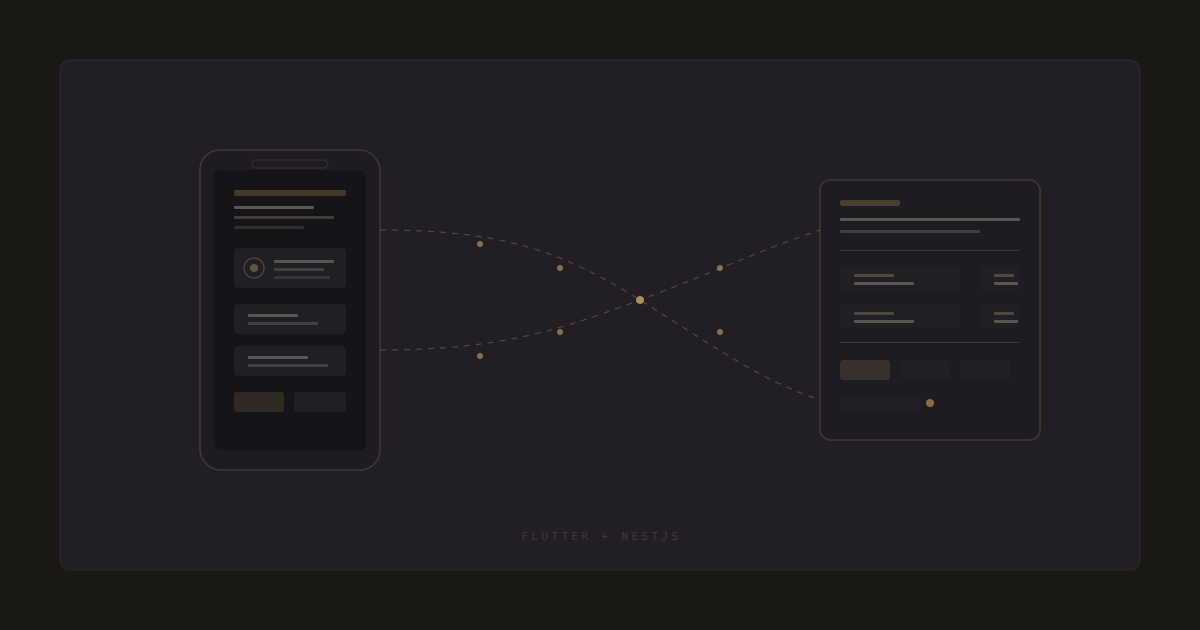
How I built MR Jobs with Flutter on the frontend and NestJS on the backend. Architecture choices, state management, and the CI/CD pipeline I run single-handedly.
Lessons from building the Velora SDK and consuming dozens of APIs. Naming, errors, pagination, and the small decisions that separate an SDK people love from one they tolerate.
Practical color theory for screens, not canvases. Contrast, perception, accessibility, and how to build a palette that works in light and dark mode without repainting everything.
Animation is a tool, not a decoration. The principles I use to decide when motion improves a product and when it gets in the way, with examples from my own work.
How to build layouts that feel intentional instead of arbitrary. Grid systems, spacing scales, and the rhythm that separates a designed interface from an assembled one.
Most social media metrics are vanity. Here are the numbers I actually look at to decide what is working, and the ones I ignore even when they look impressive.
Telegram is the most underrated platform for direct audience communication in Southeast Asia. How I build channels from zero, what content works, and why broadcast beats chat.
YouTube is two platforms in one. How I plan long-form and short-form content so they feed each other instead of competing, and why Shorts are a discovery tool, not a destination.